Sunday, September 28, 2014

Online Newspapers


Reading newspapers, even if only the headlines, is a great way to learn a language. Bearing in mind that the use of the language in newspapers is a bit different from language in everyday life, you can learn so much.
Thanks to the internet, foreign newspapers and magazines are widely available online. This is my selection of free newspapers online:

The Guardian This British newspaper's online edition was the third most widely read in the world as of June 2012
The London Evening Standard is a local, free daily newspaper, published Monday to Friday in tabloid format in London.
Metro UK is a free newspaper published in tabloid format in the United Kingdom.
The New York Times is an American daily newspaper,published in New York City. It has won more Pulitzer Prizes than any other news organization.
The Huffington Post  It calls itself the Internet Newspaper as there is no paper edition. This is the link to the American edition.
The Village Voice is a free weekly tabloid-format newspaper and news and features website in New York City that features investigative articles, analysis of current affairs and culture, arts and music coverage, and events listings for New York City.

Welcome to a New School Year!


I am so not ready but what can I do? These first few days, even weeks, are the hardest because I don't know my students and they don't know me. Hopefully, we'll get used to each other soon and everything will run like clockwork. In the meantime, I'll try my best. So far, this year looks promising. I like my students. They're eager to learn, they listen and most importantly, they're fearless! I'm feeling optimistic!
Good Luck to everyone! I hope this is a year full of learning and fun!

Monday, October 28, 2013

Goodbye, Mr Reed!!

Yesterday was not a perfect day, as the great Lou Reed passed away. There'll be no more concerts nor songs from him. It was a sad day for music or, as Don Mclean would have said, it was the day the music died. But true artists like him never die. His music will live on forever.
Enjoy!

Monday, October 21, 2013

How good are the Spanish at English? Not very, sadly.


Languageknowledge.eu is a visualization of language knowledge in Europe by Jonathan Van Parys, launched to coincide with the 2012 European Day of Languages. The site uses data from the Europeans and their languages survey by the European Commission.
When the European Commission published a new Eurobarometer survey on languages in the summer of 2012, he thought it would be fun to do something interactive with language data in order to visualize language dynamics in Europe: which languages are growing in popularity, which languages are most spoken in each country, which countries are lagging behind in language skills, etc.
It's really interesting for us, teachers of English as a foreign language, to see what's the state of things in our country. It is sad to see that little has changed and we are still far behind our fellow Europeans.

Go to the site yourselves and see the Data. The site is interactive so you can choose any language spoken in the European Union, not only English.

Wednesday, October 9, 2013

Malala for the Nobel Peace Prize

Soon we'll find out who will be awarded the Nobel Peace Prize this year. I must say that to many of us that award doesn't mean much anymore, too many undeserving recipients... But Malala is different: She is an inspiration; a strong, powerful young woman who hopefully will help change this world for the better. After watching her recent interview on The Daily Show, I feel as much in awe as Jon Stewart himself. Please watch and enjoy this wonderful interview!


Sunday, September 29, 2013

Welcome to a new school year!!


After a few months of inactivity and with the start of the new school year, this blog is coming alive again. Hopefully, and with the help of readers like you, its life will be long and fruitful ;) So please, don't forget to comment!


Sunday, February 10, 2013

Are you thinking about going to the UK? Some useful links


These are difficult times for everyone in Spain and some of us are thinking about trying another life somewhere else. Even if you are thinking of only going for a short time in order to learn the language, here's some useful links in case you are planning to go to the UK:

Floodlight is the place to go to look for courses. You can find any course and at any price here. You can also go to a public library to get more information about free courses. At least, they used to have lists when I was much younger!

Loot is the place to go to find ANYTHING: Loot is the UK's original classified ads paper with editions in London, Manchester and Liverpool. You can find a job, accomodation... anything you'll need.

If you need a temporary cheap place to stay when you first arrive in the UK, check out the YHA website. Once there it will be easier to find a more permanent place and a job too!

 You can find Job offers for Spanish speaking people here, Portal de empleo de la Consejería del Ministerio de Empleo y Seguridad Social en el Reino Unido.

If what you are looking for is summer language courses abroad, Inturjoven has a wide range of courses.


Good luck!!!

Sunday, November 4, 2012

Tim Burton's a Genius!


I've just seen the movie Frankenweenie and I loved it so I highly recommend it to anyone. Don't let the fact that it's a black and white film put you off, it is funny, sweet, sad and just lovely. It's also full of references to the first Frankenstein films with Boris Karloff as The Monster, great films as well.
So I googled some and found out that Frankenweenie is actually a remake of a short film Tim Burton made in 1984. It is on youtube (dubbed in Spanish and the original) so check it out but not until you see the full length movie!
Tim Burton has used the stop motion technique in many of his films (both long and short). This animation technique makes a physically manipulated object appear to move on its own.
It is the technique used in the following 1982 short (under 6 minutes!) by Tim Burton.
The film is called Vincent and it is a beautiful tribute to Vincent Price, who narrates it. He was an American actor best known for his distinctive voice and his roles in horror films, including many Edgar Allan Poe adaptations.
Enjoy!

Thursday, October 25, 2012

My name's Bond, James Bond

Are you excited about the new 007 (double o seven) movie? I am, a little. I'm not a great fan of the franchise but I'm really looking forward to this one. Maybe it is because our own Javier Bardem plays the villain ...
let's start enjoying Skyfall: watch the trailer and listen to the theme song by Adele:

Wednesday, October 17, 2012

A rose is a rose is a rose

The Backbone Zone Posters
The English language evolves so fast and that's not a bad thing. The real language is the one spoken by the people every day and not the one you sometimes find only in textbooks and dictionaries.
I firmly believe that and as a teacher I try to take that into account and sometimes allow my students some formal mistakes because they're really more authentic as they are widely used by native speakers. The more fluent students are familiar with them thanks to video games, television and music. They have learnt them watching their favourite shows, playing video games and listening to songs.
That creates another problem though. Through songs, dangerous words enter the language. They're dangerous because they are used mainly by teenagers, to whom those songs are aimed in the first place. They are also dangerous because they teach them to be discriminatory and violent. By giving positive words a negative meaning we are making associations which only lead to prejudice, inequity, intolerance and bigotry, AND WE MUST FIGHT THAT!!
That is what organizations like The Backbone Zone are doing, and in this case they're doing it brilliantly.
Everybody has a backbone. The Backbone Zone is a project to help students find theirs, and to give them tools to confront gender-bullying, sexual harassment, and sexist and homophobic language when they see and hear it. Check out their webpage, and facebook!

Sunday, October 14, 2012

For Malala

You've probably heard in the news about Malala Yousufzai, the Pakistani teenage blogger who was shot in the head by the Taliban in an attempt to kill not only her but women's hopes in her country.
Malala had spoken out in a blog about the Taliban's closings of most girls schools in her country, how human rights were being taken away from women and girls systematically by their regime.
It is a sad world we live in.
Malala has survived this attack but she'll live the rest of her life under death threats.
I cannot express how saddened I feel about all this. Being a woman still is a risk in the 21st century; it seems to me that even more so than decades ago.
I leave you with a few of Malala's words, but you can read her blog here:
"I had a terrible dream yesterday with military helicopters and the Taleban. I have had such dreams since the launch of the military operation in Swat. My mother made me breakfast and I went off to school. I was afraid going to school because the Taleban had issued an edict banning all girls from attending schools. Only 11 students attended the class out of 27. The number decreased because of Taleban's edict. My three friends have shifted to Peshawar, Lahore and Rawalpindi with their families after this edict.
On my way from school to home I heard a man saying 'I will kill you'. I hastened my pace and after a while I looked back if the man was still coming behind me. But to my utter relief he was talking on his mobile and must have been threatening someone else over the phone."

—Malala Yousafzai, 3 January 2009 BBC blog entry

"I was getting ready for school and about to wear my uniform when I remembered that our principal had told us not to wear uniforms - and come to school wearing normal clothes instead. So I decided to wear my favourite pink dress. Other girls in school were also wearing colourful dresses and the school presented a homely look.


My friend came to me and said, 'for God's sake, answer me honestly, is our school going to be attacked by the Taleban?' During the morning assembly we were told not to wear colourful clothes as the Taleban would object to it.
I came back from school and had tuition sessions after lunch. In the evening I switched on the TV and heard that curfew had been lifted from Shakardra after 15 days. I was happy to hear that because our English teacher lived in the area and she might be coming to school now."

 —Malala Yousafzai, 5 January 2009 BBC blog entry

Thursday, May 31, 2012

The cost of university in Europe

There's a feature in today's Guardian about the number of universities, students, the cost of studying and more interesting information about different European countries. How does Spain rate? Find out here

Wednesday, May 30, 2012

Are you a lost generation?


With this huge and long-lasting crisis, for many young Spaniards (and not so young) finding a job is an impossible task. Even if they were lucky enough to finally find one, they would most probably be underpaid and overworked. This makes me so sad... To think you will probably have to migrate to be able to earn a living!
It is not a bad thing to go abroad to work, in my opinion it is something everyone should try at least for a period of time. But the reasons you do it shouldn't be because you have no alternative. It feels like there's no future, as the Sex Pistols would say...
Let's hope the answer to the question is NO.
There's an interesting piece of news on today's Guardian about this topic. I highly recommend it so here's the link:
Unemployment Special

Monday, April 23, 2012

Happy World Book and Copyright Day!

"Translation is the first step towards the rapprochement of peoples, and is also a decentralizing experience, teaching diversity and dialogue. Translation is one of the driving principles of our creative diversity, which enriches each language through contact with all the others."

Irina Bokova, Director General
Message for World Book and Copyright Day 2012

By celebrating this Day throughout the world, UNESCO seeks to promote reading, publishing and the protection of intellectual property through copyright. 

23 April is a symbolic date for world literature, since 23 April 1616 was the date of death of Cervantes, Shakespeare and Inca Garcilaso de la Vega. 23 April is also the date of birth or death of other prominent authors such as Maurice Druon, K.Laxness, Vladimir Nabokov, Josep Pla and Manuel Mejía Vallejo.

  • So there's not much I want to add to that but I do want to finish this post with an English translation of a beautiful poem by Pablo Neruda. Neruda is one of my favourite poets and although it is much better to read poetry in its original language sometimes that's not possible. I thank all the translators who have made it possible for us to enjoy the works of so many different authors. They do an amazing job at translating the sometimes untranslatable.

    Taken from: Veinte poemas de amor y una canción desesperada (Twenty Love Poems and a Song of Despair)
    Translated by W.S. Merwin

    The poem read by Glen Close:


    Me gustas cuando callas
    by Pablo Neruda


    Me gustas cuando callas porque estás como ausente,
    y me oyes desde lejos, y mi voz no te toca.
    Parece que los ojos se te hubieran volado
    y parece que un beso te cerrara la boca.

    Como todas las cosas están llenas de mi alma
    emerges de las cosas, llena del alma mía.
    Mariposa de sueño, te pareces a mi alma,
    y te pareces a la palabra melancolía.

    Me gustas cuando callas y estás como distante.
    Y estás como quejándote, mariposa en arrullo.
    Y me oyes desde lejos, y mi voz no te alcanza:
    déjame que me calle con el silencio tuyo.

    Déjame que te hable también con tu silencio
    claro como una lámpara, simple como un anillo.
    Eres como la noche, callada y constelada.
    Tu silencio es de estrella, tan lejano y sencillo.

    Me gustas cuando callas porque estás como ausente.
    Distante y dolorosa como si hubieras muerto.
    Una palabra entonces, una sonrisa bastan.
    Y estoy alegre, alegre de que no sea cierto.


    English Translation


    I Like for You to be Still


    I like for you to be still: it as though you were absent,
    and you hear me from far away and my voice does not
    touch you

    It seems as though your eyes had flown away
    and it seems that a kiss had sealed your mouth.

    As all things are filled with my soul
    you emerge from the things, filled with my soul.
    You are like my soul, a butterfly of dream,
    and you are like the word Melancholy.

    I like for you to be still, and you seem far away.
    It sounds as though you were lamenting, a butterfly cooing like
    a dove

    And you hear me from far away, and my voice does not reach you:
    Let me come to be still in your silence.
    And let me talk to you with your silence
    that is bright as a lamp, simple as a ring.
    Your are like the night, with its stillness and constellations.
    Your silence is that of a star, as remote and candid.

    I like for you to be still: it is as though you were absent,
    distant and full of sorrow as though you had died.
    One word then, one smile, is enough.
    And I am happy, happy that it’s not true.

Thursday, March 29, 2012

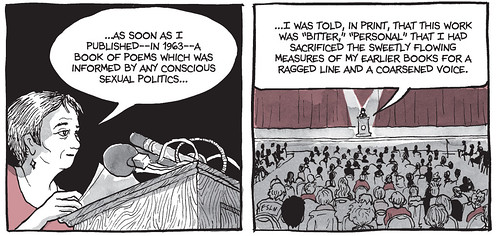
For Adrienne Rich, an inspiration


 Adrienne Rich has just died and it is a sad loss. She was a person who fought for what's right and truthful. She was a seeker of justice, of equality, of Peace. She was an amazing woman and a wonderful poet who spoke of the writer’s obligation “not to fake it, not to practice a false innocence, not pull the shades down on what’s happening next door or across town.”

In a 1984 speech she summed up her reason for writing — and, by loud unspoken implication, her reason for being — in just seven words. What she and her sisters-in-arms were fighting to achieve, she said, was simply this: “the creation of a society without domination.”(source: The New York Times)


FOR THE DEAD by Adrienne Rich
I dreamed I called you on the telephone
to say: Be kinder to yourself
but you were sick and would not answer

The waste of my love goes on this way
trying to save you from yourself

I have always wondered about the left-over
energy, the way water goes rushing down a hill
long after the rains have stopped

or the fire you want to go to bed from
but cannot leave, burning-down but not burnt-down
the red coals more extreme, more curious
in their flashing and dying
than you wish they were
sitting long after midnight

  
And now the poet herself  reads her poem "What Kind of Times Are These." Part of the Poetry Everywhere project airing on public television. Produced by David Grubin Productions and WGBH Boston, in association with the Poetry Foundation. Filmed at the Geraldine R. Dodge Poetry Festival. For more information, visit http://www.pbs.org/wgbh/poetryeverywhere/.


There's a place between two stands of trees where the grass grows uphill
and the old revolutionary road breaks off into shadows
near a meeting-house abandoned by the persecuted
who disappeared into those shadows.

I've walked there picking mushrooms at the edge of dread, but don't be fooled
this isn't a Russian poem, this is not somewhere else but here,
our country moving closer to its own truth and dread,
its own ways of making people disappear.

I won't tell you where the place is, the dark mesh of the woods
meeting the unmarked strip of light—
ghost-ridden crossroads, leafmold paradise:
I know already who wants to buy it, sell it, make it disappear.

And I won't tell you where it is, so why do I tell you
anything? Because you still listen, because in times like these
to have you listen at all, it's necessary
to talk about trees.
Adrienne Rich by Alison Bechdel

Wednesday, March 7, 2012

Happy Women's Day!


Let's celebrate International Women's Day , which is tomorrow, March 8th, with an homage to a great woman and human being. A woman who rose in spite of the things against her for not only was she a woman in the 19th century but also black and a former slave.
Sojourner Truth was an an African-American abolitionist and women's rights activist. She was born into slavery, but escaped with her infant daughter to freedom in 1826.She had to leave her other children behind because they were not legally freed in the emancipation order until they had served as bound servants into their twenties. She later said:

"I did not run off, for I thought that wicked, but I walked off, believing that to be all right."
She was also one of the first black women to go to court against a white man and win the case.
In 1851 she attended the Ohio Women's Rights Convention in Akron, Ohio where she delivered her famous speech on racial inequalities,  "Ain't I a Woman". Marius Robinson, who attended the convention and worked with Truth, recorded his version of the speech in the June 21, 1851, issue of the Anti-Slavery Bugle.
"One of the most unique and interesting speeches of the convention was made by Sojourner Truth, an emancipated slave. It is impossible to transfer it to paper, or convey any adequate idea of the effect it produced upon the audience. Those only can appreciate it who saw her powerful form, her whole-souled, earnest gesture, and listened to her strong and truthful tones. She came forward to the platform and addressing the President said with great simplicity: "May I say a few words?" Receiving an affirmative answer, she proceeded:"


 Ain't I A Woman?
Well, children, where there is so much racket there must be something out of kilter. I think that 'twixt the negroes of the South and the women at the North, all talking about rights, the white men will be in a fix pretty soon. But what's all this here talking about?
That man over there says that women need to be helped into carriages, and lifted over ditches, and to have the best place everywhere. Nobody ever helps me into carriages, or over mud-puddles, or gives me any best place! And ain't I a woman? Look at me! Look at my arm! I have ploughed and planted, and gathered into barns, and no man could head me! And ain't I a woman? I could work as much and eat as much as a man - when I could get it - and bear the lash as well! And ain't I a woman? I have borne thirteen children, and seen most all sold off to slavery, and when I cried out with my mother's grief, none but Jesus heard me! And ain't I a woman?
Then they talk about this thing in the head; what's this they call it? [member of audience whispers, "intellect"] That's it, honey. What's that got to do with women's rights or negroes' rights? If my cup won't hold but a pint, and yours holds a quart, wouldn't you be mean not to let me have my little half measure full?
Then that little man in black there, he says women can't have as much rights as men, 'cause Christ wasn't a woman! Where did your Christ come from? Where did your Christ come from? From God and a woman! Man had nothing to do with Him.
If the first woman God ever made was strong enough to turn the world upside down all alone, these women together ought to be able to turn it back , and get it right side up again! And now they is asking to do it, the men better let them.
Obliged to you for hearing me, and now old Sojourner ain't got nothing more to say.


In the following video, Poet Alice Walker (author of The Color Purple) reads the 1851 speech as part of a reading from Voices of a People's History of the United States (Howard Zinn and Anthony Arnove,) November 11, 2006 in Berkeley, California.

Thursday, March 1, 2012

WORLD BOOK DAY 2012

World Book Day is the biggest celebration of its kind, anywhere. Millions and millions of book vouchers given out, great free books for kids, excitement everywhere (on blogs, in newspapers, on TV and in schools, libraries and, of course, bookshops), people coming together (including lots and lots of young readers) in a big, loud, happy celebration of reading.
We can join in the celebration from Spain by downloading the brand new World Book Day App  for iPhone, iPad and iPod touch on the iTunes store, the low, low price of absolutely FREE!
It includes six brilliant short stories written especially for World Book Day by some of the best Young Adult authors in the world!

Let's celebrate some more with this poem by Dr Seuss:


I Can Read With My Eyes Shut!
Dr. Seuss

I can read in red. I can read in blue.
I can read in pickle color too.
I can read in bed, and in purple. and in brown.
I can read in a circle and upside down!
I can read with my left eye. I can read with my right.
I can read Mississippi with my eyes shut tight!
There are so many things you can learn about.
But…you’ll miss the best things
If you keep your eyes shut.
The more that you read, the more things you will know
The more that you learn, the more places you’ll go.
If you read with your eyes shut you’re likely to find
That the place where you’re going is far, far behind
SO…that’s why I tell you to keep your eyes wide.
Keep them wide open…at least on one side.

Monday, February 13, 2012

LOVE IS...


To celebrate Valentine's Day I'm posting a poem written by Adrian Henri for his short-lived (late 60s) Poetry-Rock band The Liverpool Scene. It is a fun way of looking at poetry which many of you will appreciate. It's like a pop song made into a poem, a pop poem maybe? Oh, how I love the wonderful and sometimes unexpected world of poetry!

Love Is...

Love is feeling cold in the back of vans
Love is a fanclub with only two fans
Love is walking holding paintstained hands
Love is
Love is fish and chips on winter nights
Love is blankets full of strange delights
Love is when you don't put out the light
Love is
Love is the presents in Christmas shops
Love is when you're feeling Top of the Pops
Love is what happens when the music stops
Love is
Love is  when you open Valentines
Love is when you read those awful lines(?)
Love is when you read between the lines*
Love is
Love is you and love is me
Love is a prison and love is free
Love's what's there when you're away from me
Love is
Adrian Henri

* These three lines are from the version in the following video, the original went like this:
Love is white panties lying all forlorn.
Love is pink nightdresses still slightly warm.
Love is when you have to leave at dawn.


Monday, February 6, 2012

WHAT THE DICKENS?

Charles Dickens by David Levine

Dickens' 200th anniversary will be marked tomorrow in ceremonies across the world.
The Prince of Wales and the Duchess of Cornwall will be leading celebrations in the United Kingdom and Charles will lay a wreath on Dickens' grave at Westminster Abbey, where he was buried in 1870.
Ralph Fiennes, who will next be seen as Magwitch in a new film adaptation of Great Expectations, will read an extract from Bleak House with readings also being given by Mark Dickens, great-great-grandson of Charles Dickens.

The Schools minister Nick Gibb has said today that Great Expectations is one of the books all children should read before they leave primary school. The truth is that it may be a little too hard for eleven-year-olds to read it as Dickens wrote it. (source)
 
The Guardian is making it easier for us as they have published the digested read versions of three of his finest books, Great Expectations, Bleak House and David Copperfield, at guardian.co.uk/books. Who can resist Pip, Miss Havisham, Lady Dedlock, Steerforth and Dopey Dora? Over the course of the year, they will be digesting all Dickens's greatest novels. Next up this month? What better for these miserable days of austerity than Hard Times? Give them a try!

The following is a cartoon about the life and times of Dickens made by the BBC. Turn on (or activate) the subtitles for an easier viewing.


I'm also posting one of the most famous beginnings of a novel in English. From A Tale of Two Cities:

"The Period


It was the best of times, it was the worst of times,
it was the age of wisdom, it was the age of foolishness,
it was the epoch of belief, it was the epoch of incredulity,
it was the season of Light, it was the season of Darkness,
it was the spring of hope, it was the winter of despair,
we had everything before us, we had nothing before us,
we were all going direct to Heaven, we were all going direct
the other way--in short, the period was so far like the present
period, that some of its noisiest authorities insisted on its
being received, for good or for evil, in the superlative degree
of comparison only."


Performed by Paul Adams for LibriVox.org from the Project Gutenberg text. From "A Tale of Two Cities" by Charles Dickens, at http://www.gutenberg.org/etext/98. This video, #01, contains Book the First - Recalled to Life, Chapter I - The Period. The complete audiobook read by Paul Adams is available at http://librivox.org/a-tale-of-two-cities-by-charles-dickens-2/.


For more on Dickens:
The Complete Works of Charles Dickens

Thursday, January 26, 2012

European stereotypes


There's a very interesting article in today's Guardian about European stereotypes , part of the series on Europe they are doing . Six leading newspapers (including El Pais) from the largest EU countries have come together in a joint project to build up a more nuanced picture of the EU and explore what Europe does well and what not so well. In European stereotypes: what do we think of each other and are we right? - interactive , the six newspapers in the Europa project were asked to stereotype each other, and then asked cultural commentators in each country to assess how accurate they are.
Give it a try, see if you agree...