Wednesday, April 27, 2011

MOTHER'S DAY


Mother's Day is celebrated in Spain the first Sunday in May, which this year is next Sunday, May 1st. Though it is a celebration found all around the world, it isn't celebrated on the same date: In the UK and Ireland, Mothers' Day (or Mothering Sunday) is celebrated on the fourth Sunday during the period of Lent. In the US, Canada, Australia and New Zealand, Mothers' Day is celebrated on the second Sunday in May.


Let's celebrate it too with the "Mother's Day Proclamation" by Julia Ward Howe. Julia Ward Howe (May 27, 1819 – October 17, 1910) was a prominent American abolitionist, social activist, and poet. This poem of hers was one of the early calls to celebrate Mother's Day in the United States. Written in 1870, Howe's Mother's Day Proclamation was a pacifist reaction to the carnage of the American Civil War. The Proclamation was tied to Howe's feminist belief that women had a responsibility to shape their societies at the political level.

Mother's Day Proclamation
Arise then...women of this day!
Arise, all women who have hearts!
Whether your baptism be of water or of tears!
Say firmly:
"We will not have questions answered by irrelevant agencies,
Our husbands will not come to us, reeking with carnage,
For caresses and applause.
Our sons shall not be taken from us to unlearn
All that we have been able to teach them of charity, mercy and patience.
We, the women of one country,
Will be too tender of those of another country
To allow our sons to be trained to injure theirs."

From the voice of a devastated Earth a voice goes up with
Our own. It says: "Disarm! Disarm!
The sword of murder is not the balance of justice."
Blood does not wipe our dishonor,
Nor violence indicate possession.
As men have often forsaken the plough and the anvil
At the summons of war,
Let women now leave all that may be left of home
For a great and earnest day of counsel.
Let them meet first, as women, to bewail and commemorate the dead.
Let them solemnly take counsel with each other as to the means
Whereby the great human family can live in peace...
Each bearing after his own time the sacred impress, not of Caesar,
But of God -
In the name of womanhood and humanity, I earnestly ask
That a general congress of women without limit of nationality,
May be appointed and held at someplace deemed most convenient
And the earliest period consistent with its objects,
To promote the alliance of the different nationalities,
The amicable settlement of international questions,
The great and general interests of peace.


Here's a video inspired by this poem, made by the Maine Women's Fund:


Sunday, April 10, 2011

Easter Eggs!


Easter Sunday, we were walking
Easter Sunday, we were talking...

Now that Easter is coming I think I should write a post about it but the fact is that you probably know more about Easter than me and, even if you don't, you can always google it. So I've decided to have some fun and hide some virtual easter eggs in my blog.
A virtual easter egg is an intentional hidden message, in-joke or feature in a work such as a computer program, web page, video game, movie, book or crossword. Typically, easter eggs are used to display the credits for the development team or to display a humorous message. To see an easter egg, you need to know a special procedure or sequence of keystrokes.
See if you can find the hidden easter eggs ;)
I just love  Savage Chickens by Doug Savage

Thursday, March 31, 2011

OMG! Kudos to the OED!

IMO,the English are much more progressive about their language than we will ever be. Our "Academia de la lengua" is an institution so rigid and old fashioned that it hinders the language instead of promoting it. Most of its members have probably never heard of Facebook or Twitter (and who hasn't?) and I even doubt they use their mobile phones for something other than receiving calls, let alone texting.
Okay, I may be exaggerating a little but there is no such thing as an "Academy of the English Language", which makes English a living, evolving, ever-changing language. It's true that Spanish is alive too but unfortunately new terms and words are much harder to be accepted and used by the media. 
A great example of this is the latest online edition of the Oxford English Dictionary (OED), the venerable last word on proper language.  Several abbreviations ''' or "initialisms" have been added. Those include OMG (Oh my god), LOL (laughing out loud), TMI (too much information), FYI (for your information) and BFF (best friends forever). The OED explained the decision extensively in an online statement.  The OED explains that shorthands such as LOL and OMG have gone beyond just saving space and acquired nuanced meanings of their own, with "a bit more than simple abbreviation going on." The new "initialisms," or abbreviations made up of the first letters of each word in the phrase to which they refer, include "OMG" (oh my god), "LOL" (laughing out loud), "IMHO" (in my humble/honest opinion), "TMI" (too much information), "BFF" (best friends forever), "FYI" (for your information) and WAG (wives and girlfriends). They also comment that some of these have been around for a really long time.
An interesting google tool you can use to find out how long and when a certain word or expression has been used is timeline. You just need to select timeline from the search tools menu when you do a search. Try it out, it's fun!

Monday, March 28, 2011

The Guardian's "Spanish Week"


The British newspaper The Guardian is running a series called New Europe, an indepth look at four European countries – with a week exploring every aspect of their cultures, economies and day-to-day lives.
Well, this week's turn is Spain's and I think this is a great opportunity for us to see how we are perceived by the people whose language we are learning and love so visit their site to find out what they think about us. If you don't agree, you can always tell them ;)

April Fool's Day

April Fool's Day or All Fool's Day occurs annually on April 1. The day is generally observed by playing a practical joke on a "victim" who soon becomes known as an April Fool. This custom is thought to have started in France during the 16th century but the British are credited with bringing it to the United States.
The commonly accepted origin of April Fool's Day involves changes in the calendar. At one time, the New Year celebration began on March 25 and ended on April 1. However, in 1582, King Charles IX adopted the Gregorian calendar and accepted the beginning of the new year as January 1. Those who refused to acknowledge the new date or simply forgot received foolish gifts and invitations to nonexistent parties. The butt of such a prank was known as a "poisson d'avril" or "April fish."

There have been numerous hoaxes on this day and according to this site, The Museum of Hoaxes, the following is the best one:

The Swiss Spaghetti Harvest spaghetti harvest1957: The respected BBC news show Panorama announced that thanks to a very mild winter and the virtual elimination of the dreaded spaghetti weevil, Swiss farmers were enjoying a bumper spaghetti crop. It accompanied this announcement with footage of Swiss peasants pulling strands of spaghetti down from trees. Huge numbers of viewers were taken in. Many called the BBC wanting to know how they could grow their own spaghetti tree. To this the BBC diplomatically replied, "place a sprig of spaghetti in a tin of tomato sauce and hope for the best."
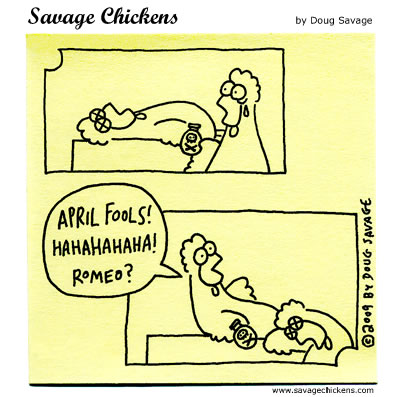
I know in Spain we do not celebrate April Fool's Day but Holy Innocents' Day (December 28) but the spirit is the same... So, what are your favourite jokes to play on someone?

Saturday, March 26, 2011

Earth Hour 2011

Today, March 26, at 8:30 p.m. local time, we are being urged to turn out all our lights for one hour for the fourth annual Earth Hour. There is much discussion out there as to whether or not this actually addresses the real issue of power conservation or whether it’s just a token gesture. World Wildlife Fund encourages us to make this the first step in changing our habits and suggest ways to take action on a number of different issues that can make a continual difference.
In 2010, 126 countries and over 1 billion people participated. This year, 131 countries and provinces have committed to participation.
Earth Hour this year is not only to raise awareness towards the need to take action on climate change, but to show solidarity with the Japanese people: after the recent tragedies in Japan, millions people now are surviving without electricity.
So, Will you join in?

Friday, March 18, 2011

About language and mistakes

There is an article today on Yahoo about language, What your verbal fillers say about you, that I think you may find both interesting and enlightening.
This article has made me think. I'm getting old and one of the signs is the number of mistakes I make every day regarding language. I don't mean grammar or vocabulary mistakes (which I also make but for a different reason: my command of the language, either English or Spanish, is far from perfect) but those slips of the tongue and pen you have sometimes witnessed.
So, too often I think pen but say paper or mean sausage but say hamburger. Slips of the pen (when you think of a word but write another) are fortunately much less frequent but nevertheless as worrying. It is also difficult sometimes to find the right word and I'm very often at a loss for words and unable to say what I really mean. Michael Erard in his book “Um ... ” confirms this: age is an important factor

In his informal study of verbal mistakes, he states that the average person will commit somewhere between 7 and 22 slips of the tongue each day and from two to four times a day will struggle, for an embarrassing length of time, to find the right word or name. It only gets worse. As the years go by, speech reverts to childhood levels of disfluency, with more pauses, more errors, more repeated words, but even the peak years are not great: up to 8 percent of the average person’s word output consists of meaningless fillers and placeholders like um, uh and er. The simplest explanation for all verbal mistakes, Mr. Erard writes, is that they occur “as the brain shifts from planning to executing or back again.” They also, most linguists agree, follow the structure of the language.